
HiiL’s new report, Measuring justice from the users’ perspective: a first look at the Justice Services Measure, asks a deceptively simple question: what does it actually mean for a justice service to be people-centred — and can we measure it?
People-centred justice has become an increasingly important ambition in justice reform. But there is a problem. It is remarkably easy to call something people-centred. Much harder is to show, with evidence, that it actually responds to the people using it.
“A word that can describe anything ends up describing nothing.”
That is one of the challenges behind HiiL’s new report. If every well-intentioned justice initiative can be described as people-centred, the term risks becoming a label rather than a meaningful standard. The Justice Services Measure (JSM) takes a step towards changing that: turning people-centricity from a principle into something that can be observed, measured and improved.
Looking at justice from the other side of the desk
Justice systems have traditionally measured themselves by institutional indicators: case volumes, clearance rates, and other activity measures. These tell us something about how a system or a service is functioning. They tell us much less about whether someone’s problem was actually resolved, whether they felt fairly treated, or whether the process was so difficult that they would avoid it next time. The JSM shifts the focus towards the experience of the person using a justice service. It identifies four dimensions of people-centricity: outcome, process, cost and usability.
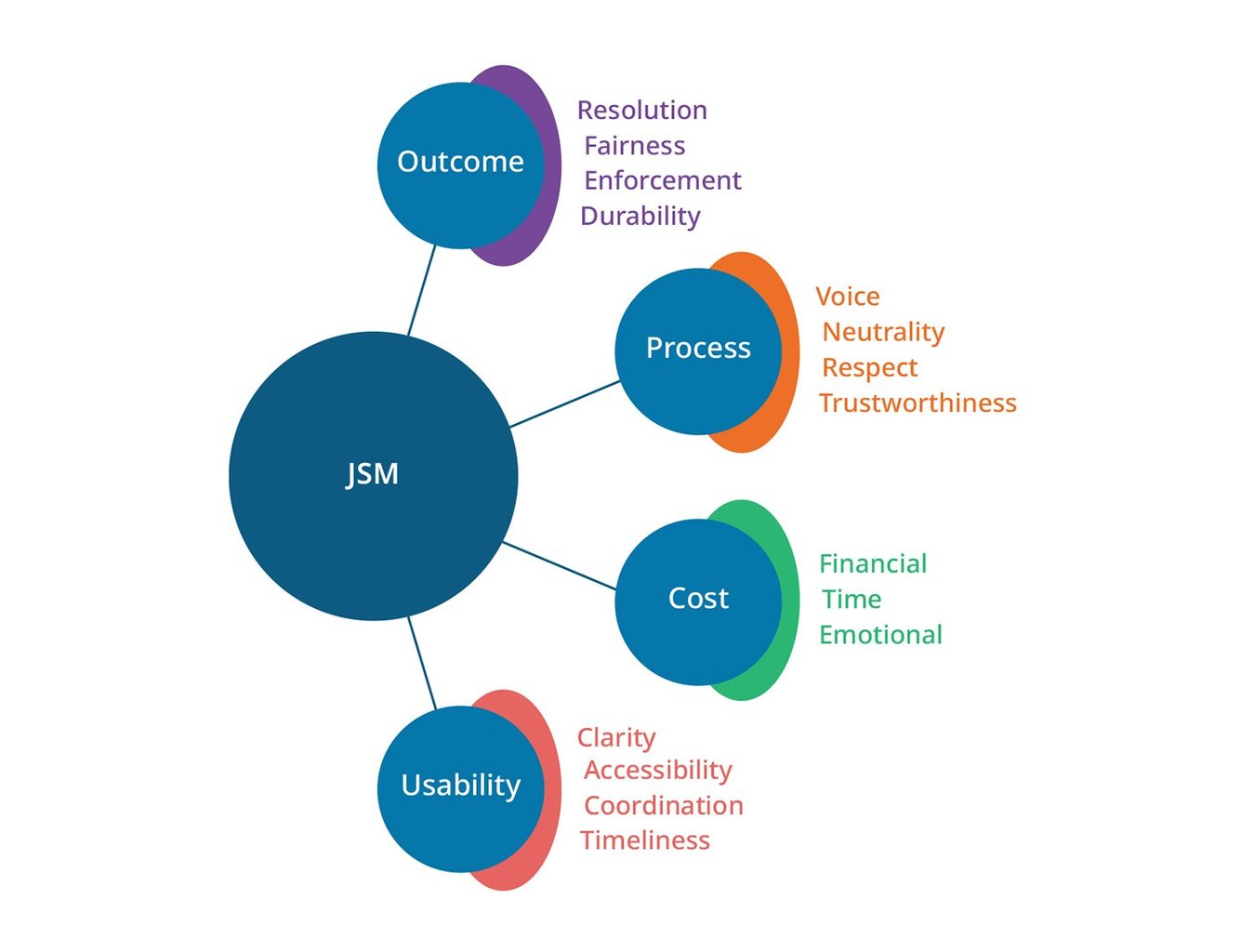
Caption: The structure of the Justice Services Measure
Outcome: Did it solve the problem?
A justice service needs to do more than produce a decision. The JSM asks whether the problem was resolved, whether the resolution was fair, whether it proved durable and whether it was actually enforced. A judgment that is never enforced may look successful on paper. For the person involved, it may be anything but.
Process: Was the journey fair?
Justice is also about what happens along the way. People evaluate whether they were able to tell their side of the story, whether the decision-maker was neutral, whether they were treated with respect and whether they trusted the provider to act in good faith. A person can lose a case and still experience the process as fair. Equally, getting the outcome you wanted does not necessarily mean you felt heard or respected.
Cost: What did justice take from you?
A process can be fair and still fail the person using it. Financial costs are only part of the equation. Time, travel, emotional strain and psychological stress all shape whether a justice service is genuinely people-centred. As the report puts it, justice that “bankrupts, exhausts, or terrifies” its users cannot be considered people-centred.
Usability: How difficult was it to get through?
Perhaps the most interesting finding from the research was the emergence of a fourth dimension: usability. Usability captures the everyday friction of using a justice service: wasted trips, queues, confusing referrals, complicated forms, inadequate information and processes that require people to navigate multiple offices or providers. These may sound like minor administrative problems. For someone trying to resolve a dispute, they can determine whether they manage to pursue justice at all.
When the user gets a say
In Nigeria and Ethiopia, the JSM was tested with people who had used Community Justice Centres to resolve problems ranging from land and property disputes to family problems and violent crime. Their experiences showed why a single measure of “satisfaction” can only tell us so much. A person might feel respected but still be frustrated by delays. A service might be affordable but difficult to navigate. A dispute might be resolved, but leave the person uncertain whether the agreement will actually hold. And sometimes the problem is not a dramatic failure of justice at all, but something much more ordinary: another trip to the centre, another queue, another form, another unanswered question. This is precisely what the JSM is designed to make visible: there is no one-size-fits-all way to ask people about their experience of justice. Reaching users, building trust, adapting questions to different languages and contexts, and interpreting what people tell us all matter. The ambition behind the JSM is not to create another ranking or performance score. It is to give justice providers something they have too often lacked: a structured way to hear where the experience breaks down, understand why, and improve the service accordingly.
The question, then, is bigger than whether a justice service scores well. Did it actually work for the person who needed it? And when it didn’t, did anyone listen?
The Justice Services Measure is a first attempt to quantify and make those questions impossible to ignore.
Read the full report: Measuring Justice from the User’s Perspective: A First Look at the Justice Services Measure